[Abstract]
After cleaning, precision components often retain residual moisture in internal cavities, grooves, oil passages, and mold cavities. Traditional vacuum drying methods only evaporate surface moisture, leading to incomplete drying, which can cause water stains and rust, reduce product yield, and interfere with subsequent processing steps. This article analyzes the structural principles and differentiated advantages of two patented vacuum drying systems from Big Bird Industrial, providing guidance for selecting equipment to address moisture retention and uneven drying challenges in precision cleaning lines.
[Keywords]
Vacuum drying equipment, vacuum-based water removal, component drying, engine block drying, precision cleaning and drying, vacuum drying patent, industrial drying equipment
I. Why Is Component Drying the "Last Mile" of Precision Cleaning?
If precision components are not thoroughly dried after cleaning, residual moisture remains trapped within internal cavities, grooves, oil channels, and mold cavities. This retained moisture not only causes water stains and corrosion but also reduces final product yield and may lead to quality fluctuations during assembly and later processing stages. As a result, drying effectiveness has become a critical quality control point in precision cleaning lines—and a long-standing industry-wide challenge.
II. Residual Moisture: An Inevitable Industry Pain Point
Traditional vacuum drying relies primarily on negative pressure to evaporate surface moisture, making it difficult to reach moisture trapped deep inside cavities, grooves, oil passages, or mold cavities. Key issues include:
· Uneven drying: Surface dry while interior remains wet, resulting in substandard overall dryness;
· Reduced yield: Residual moisture leads to rust and staining, lowering product quality;
· Process interference: Moisture seeps out during downstream operations, affecting assembly and machining quality;
· Limited adaptability: Components with complex internal geometries or multiple specifications are especially difficult to fully dry.
III. Big Bird Industrial’s Two Patented Vacuum Drying Systems
To address these challenges, Harbin Big Bird Industrial Co., Ltd. has independently developed two patented vacuum drying systems featuring innovative, differentiated designs that effectively eliminate moisture retention and ensure uniform drying.
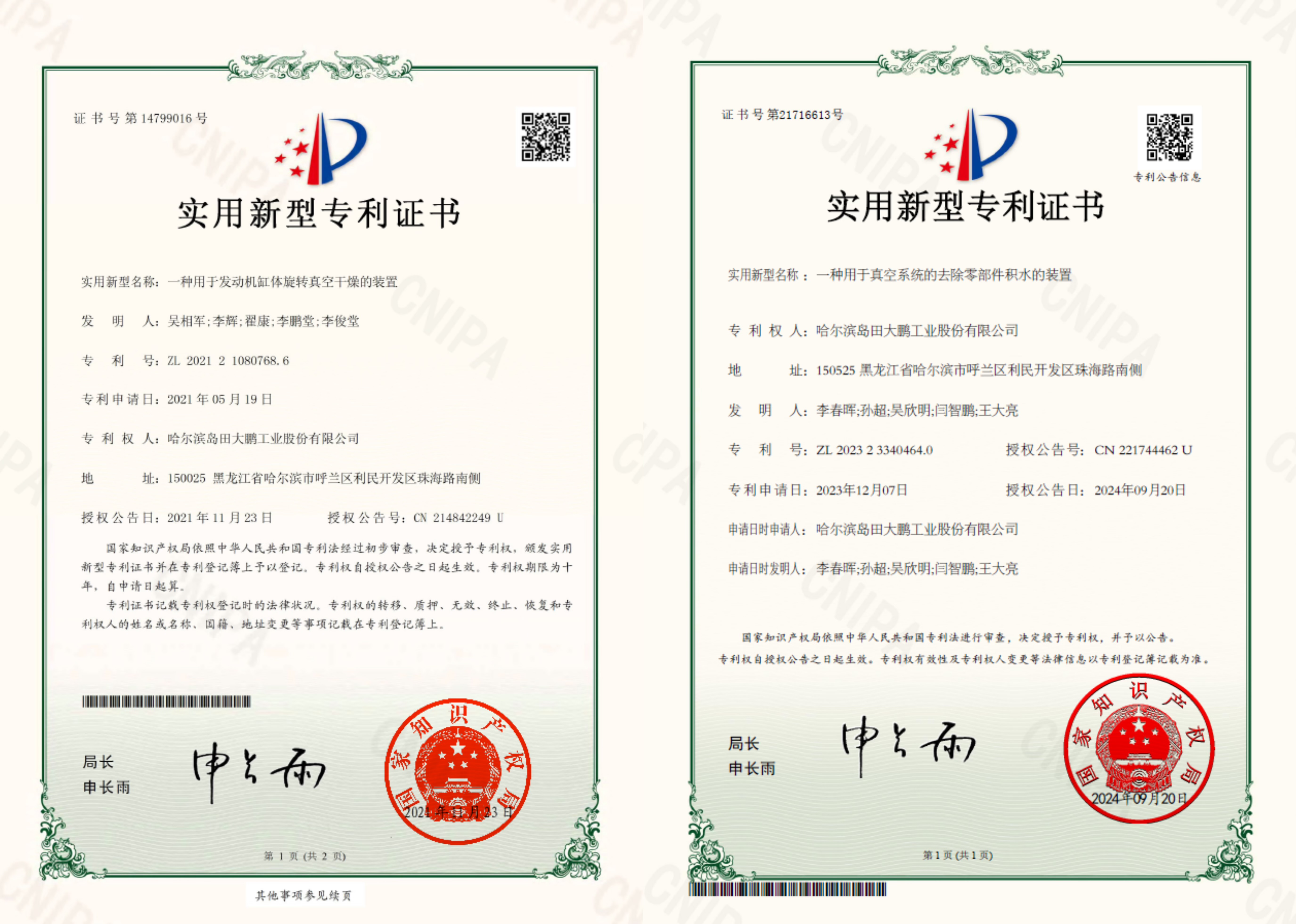
1. A Device for Removing Water from Components in a Vacuum System
Structure: Elevating sealed vacuum chamber + extended drying nozzle + dual suction vacuum system + automated loading/unloading mechanism.
Process: First, vacuum evaporation removes surface moisture; then high-pressure airflow blows away accumulated water; finally, secondary vacuum ensures complete drying.
Advantages: Compact design with high automation; dual suction ports accelerate evacuation and shorten cycle time; modular components enable easy maintenance; compatible with various precision part sizes; significantly reduces risks of rust and processing defects while balancing production capacity and energy efficiency.
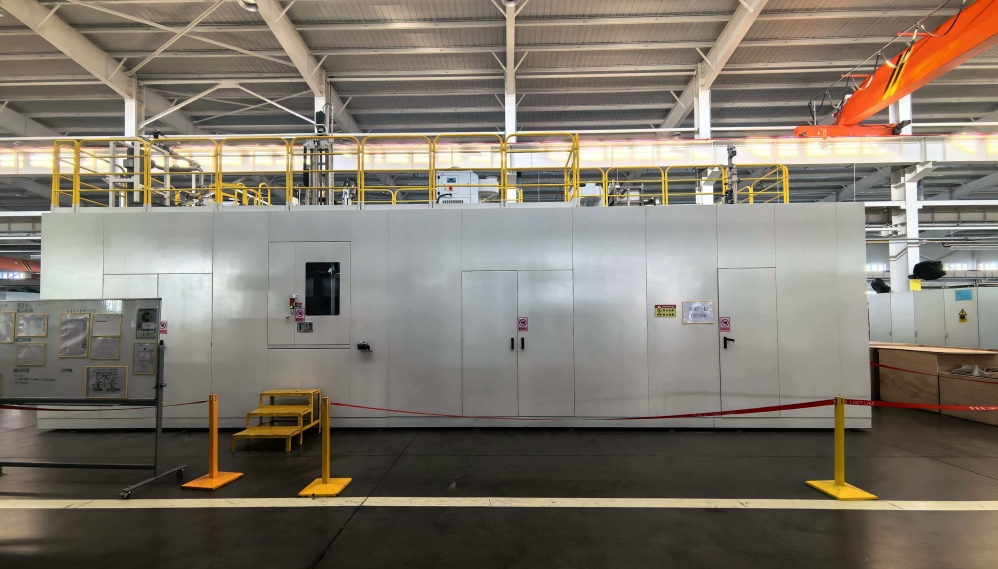
2. A Rotary Vacuum Drying Device for Engine Blocks
Structure: Spring-loaded self-adaptive clamping fixture + rotary drive mechanism + enclosed movable vacuum chamber + roller conveyor for automatic transport.
Process: Roller conveyors deliver engine blocks into position; fixtures securely hold parts during 360° synchronized rotation under vacuum, centrifugally expelling internal moisture and increasing contact area between moisture and negative pressure, thereby reducing drying time.
Advantages: Integrated positioning, locking, and automatic loading/unloading enables seamless integration with automated production lines; robust frame-welded structure ensures stability and low component wear; meets high-standard drying requirements for engine blocks and can be retrofitted onto existing cleaning lines to improve drying uniformity and overall efficiency.
IV. Key Considerations for Vacuum Drying Equipment Selection and Implementation
- Evaluate the workpiece: Internal cavity structure, oil channel distribution, and single-piece weight determine whether a fixed chamber or rotating drying system should be adopted.
- Assess the production line: Determine if automatic loading/unloading is required and whether integration with existing cleaning lines needs modification.
- Consider cycle time: Dual suction, rotation, and other structural features directly affect vacuum speed and operational cycle time.
- Evaluate maintenance: Modularity and spare parts consumption influence long-term operation and maintenance costs.
- Review performance metrics: Use dryness (no water marks), yield improvement, and energy consumption as acceptance criteria.
V. Big Bird Industrial's Equipment Portfolio and Qualifications
Harbin Big Bird Industrial Co., Ltd. (shortened to "Big Bird Industrial") was established in 2005 and recognized as a national "Specialized, Refined, Unique, and Innovative" small giant enterprise. The company specializes in integrated solutions for precision industrial cleaning equipment, eco-friendly cleaning agents, and machine vision inspection, supported by 87 authorized patents that form a strong technological moat. Committed to the mission of "being a trusted partner," Big Bird Industrial envisions "leading China’s precision industrial cleaning industry, becoming number one in China and world-leading," and consistently collaborates with customers for mutual growth.
Frequently Asked Questions (FAQ)
Q: Can vacuum drying equipment be directly integrated into an existing cleaning production line?
A: Rotating vacuum drying units can be retrofitted onto existing cleaning lines. The water-removal device features modular design, enabling seamless integration with automatic loading/unloading and production line synchronization, minimizing implementation barriers.
Q: Which types of workpieces are best suited for this equipment?
A: The water-removal unit accommodates various specifications of precision components. The rotating vacuum drying unit is specifically designed for high-demand parts such as engine blocks, but also suitable for other components with internal cavities and oil channels.
Q: How do you determine if drying is successful?
A: Dryness (no visible water traces on the workpiece), improved product yield, and energy consumption are standard acceptance criteria. Combined with first-piece and batch testing validation, Big Bird Industrial provides comprehensive support throughout the acceptance process.
Q: What advantages does your equipment offer compared to traditional vacuum drying methods?
A: Traditional methods only evaporate surface moisture and struggle to remove internal cavity water. Big Bird Industrial’s equipment employs a combination of dual suction acceleration, high-pressure airflow dispersion, and rotational water ejection, achieving thorough two-layer drying, significantly improving drying uniformity and product yield.