


The appearance quality of painted automotive bumpers directly affects the overall visual appeal of a vehicle. Minute surface imperfections such as fine particles, shallow scratches, and tiny dents—some as small as 0.2 millimeters, finer than a human hair—are difficult to detect with the naked eye, resulting in low inspection efficiency and high rates of missed defects—a long-standing challenge in automotive paint shops.
Harbin Shimada Big Bird Industrial Co., Ltd.'s mature bumper defect vision inspection system leverages optical imaging and dual AI algorithms to achieve fully automated, high-precision quality control.
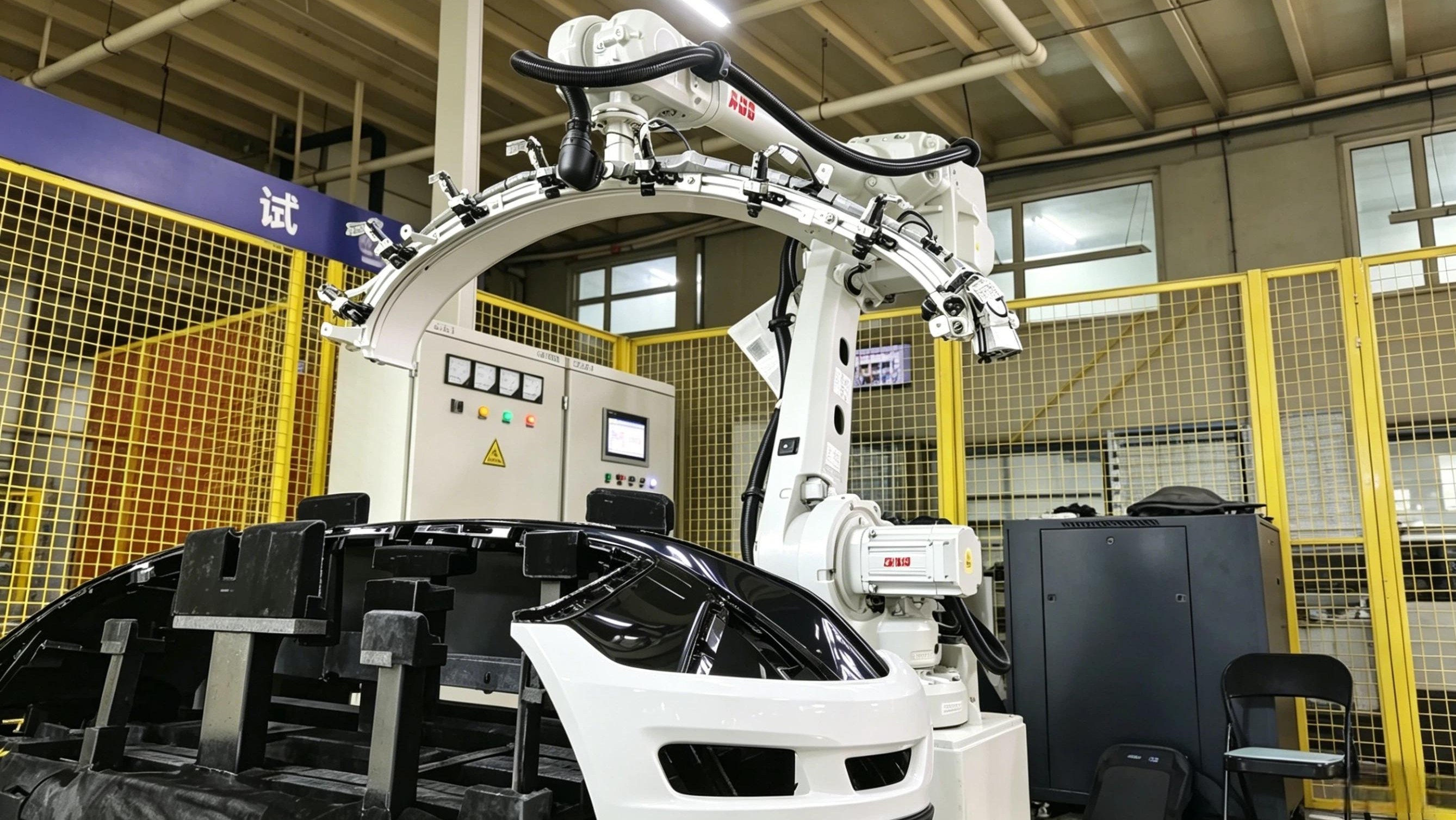
The core components of the system include a C-shaped stripe light source, five industrial cameras, and a robotic arm. The light source uses a microcontroller to drive three LED panels arranged in a ring formation, producing horizontal and vertical stripe patterns at a standard frequency of 100 flashes per second. Surface irregularities cause distortions and breaks in the light pattern, creating clear features for defect detection. Five 1.5-megapixel monochrome industrial cameras are synchronized and mounted on the side of the light source. The robotic arm moves uniformly across the curved surface of the bumper at speeds between 800 and 1000 mm/s, continuously capturing full-area images that cover every curved section of the bumper.
After image data is uploaded, the system employs dual algorithm cross-validation to minimize false positives and missed detections. The first algorithm uses traditional image processing to identify suspicious areas, accurately distinguishing common defects such as particles, scratches, and stains. The second algorithm combines deep learning models with tile-cutting technology to analyze large images by breaking them into smaller sections, enabling precise identification of irregular, minute flaws. The two sets of detection results are automatically compared and merged, ensuring double-layered accuracy.
The system delivers impressive performance: capable of detecting surface defects as small as 0.2 mm, with a stable defect detection rate exceeding 90%. From image capture to complete report generation for a single bumper, the entire process takes no more than 10 seconds.
Inspection results are visually displayed on the operator interface, with defect locations precisely marked on the bumper’s 3D digital model. Users can click on any defect point to view its actual captured image, enabling workers to quickly locate and repair issues.
By integrating stripe-based optical imaging, multi-camera full-area acquisition, and dual AI fusion detection, this automated inspection system completely replaces inefficient manual visual checks, establishing a highly efficient and reliable intelligent quality control solution for automotive bumper painting.